

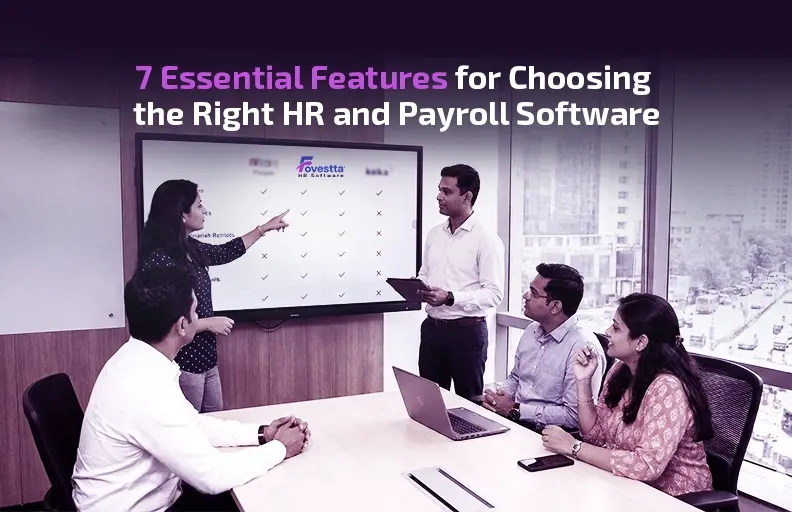
7 Essential Features for Choosing the Right HR and Payroll Software
Selecting the right HR and payroll software solutions is crucial for businesses of all sizes, especially for startups looking for the best hr tools for startups to build efficient foundations. A fully integrated system that handles both HR and payroll can drastically reduce errors, ensure compliance, and free up your team to focus on strategic growth.
Here are the 7 essential features to evaluate before committing to a system, ensuring you pick the hr and payroll software in India or anywhere else you operate:
1. Statutory Compliance and Tax Automation 🇮🇳
For any payroll management software this is non-negotiable, particularly in a complex environment like India. The software must automatically calculate and file:
- Taxes: TDS, Professional Tax (PT).
- Statutory Deductions: Provident Fund (PF), Employees’ State Insurance (ESI).
- Reports: Auto-generate all required compliance reports and challans (e.g., Form 16, Form 24Q).
A system that automatically updates to reflect the latest changes in labor and tax laws is vital to avoid penalties and legal issues.
2. Seamless Time, Attendance, and Leave Integration
Your HR and payroll software must be able to directly sync attendance and leave data with payroll calculations.
- Accuracy: Eliminate manual data entry and human error by automatically factoring in days worked, leaves taken, and overtime hours to calculate the final salary.
- Real-time Tracking: Enables managers and employees to track time off and attendance in real time.
3. Employee Self-Service (ESS) Portal
The ESS portal is a powerful feature that transforms the employee experience and reduces HR admin work.
- Access: Employees can view and download their payslips, tax forms, and expense reimbursement details.
- Updates: Allows employees to update personal information (like addresses or bank details) themselves.
- Requests: Handles leave and expense claim submissions digitally.
4. Scalability and Customization
Whether you’re a startup looking for Free HR management software to begin with, or a growing enterprise, the system must scale with you.
- Scalability: The software should effortlessly handle growth, from adding new employees to managing different pay cycles or departments.
- Flexibility: It should allow for customizable salary structures to accommodate various components like bonuses, commissions, and shift differentials without needing spreadsheets.
5. Security and Data Privacy
Payroll management software handles the most sensitive employee information. Robust security is paramount.
- Data Protection: Look for features like role-based access control (ensuring employees only see data relevant to their role), data encryption, and secure cloud storage.
- Audit Trails: The system should log every change made, providing a clear audit trail for compliance and accountability.
6. Reporting and Analytics
A good HRMS is not just an administrative tool; it’s a strategic one.
- Insight: The software must generate detailed, real-time reports on payroll costs, headcount, attrition rates, and statutory contributions.
- Decision Making: This data helps you monitor expenses, forecast budgets, and make informed decisions about workforce strategy and compensation.
7. Integration Capabilities
The platform should not operate in a silo. It needs to connect easily with your other business tools.
- HRIS/Payroll Link: The most efficient HR software solutions offer unified HR and payroll on one platform.
- Third-Party Tools: Check for seamless integration with accounting software (e.g., Tally, SAP) and other HR modules like performance management and applicant tracking systems (ATS).
Choosing the right system means investing in efficiency, accuracy, and compliance. Prioritizing these seven features will ensure you select a powerful, future-proof HR and payroll software that supports your business growth.
Conclusion: Making the Right Investment
Choosing the right HR and payroll software is more than just a logistical task; it is a critical investment in your company’s future efficiency, compliance, and growth. By focusing on these seven essential features.
